What Is Leverage in Trading and How Does It Work?
Leverage is one of the most important concepts to understand before trading financial markets. It allows traders to control a larger market position with a smaller amount of capital, increasing both potential profits and potential losses.
While leverage can make trading more capital-efficient, it also increases risk. Understanding how it works is essential before opening a leveraged position.
What Is Leverage?
Leverage allows you to gain exposure to a position that is larger than the amount of money you commit as margin.
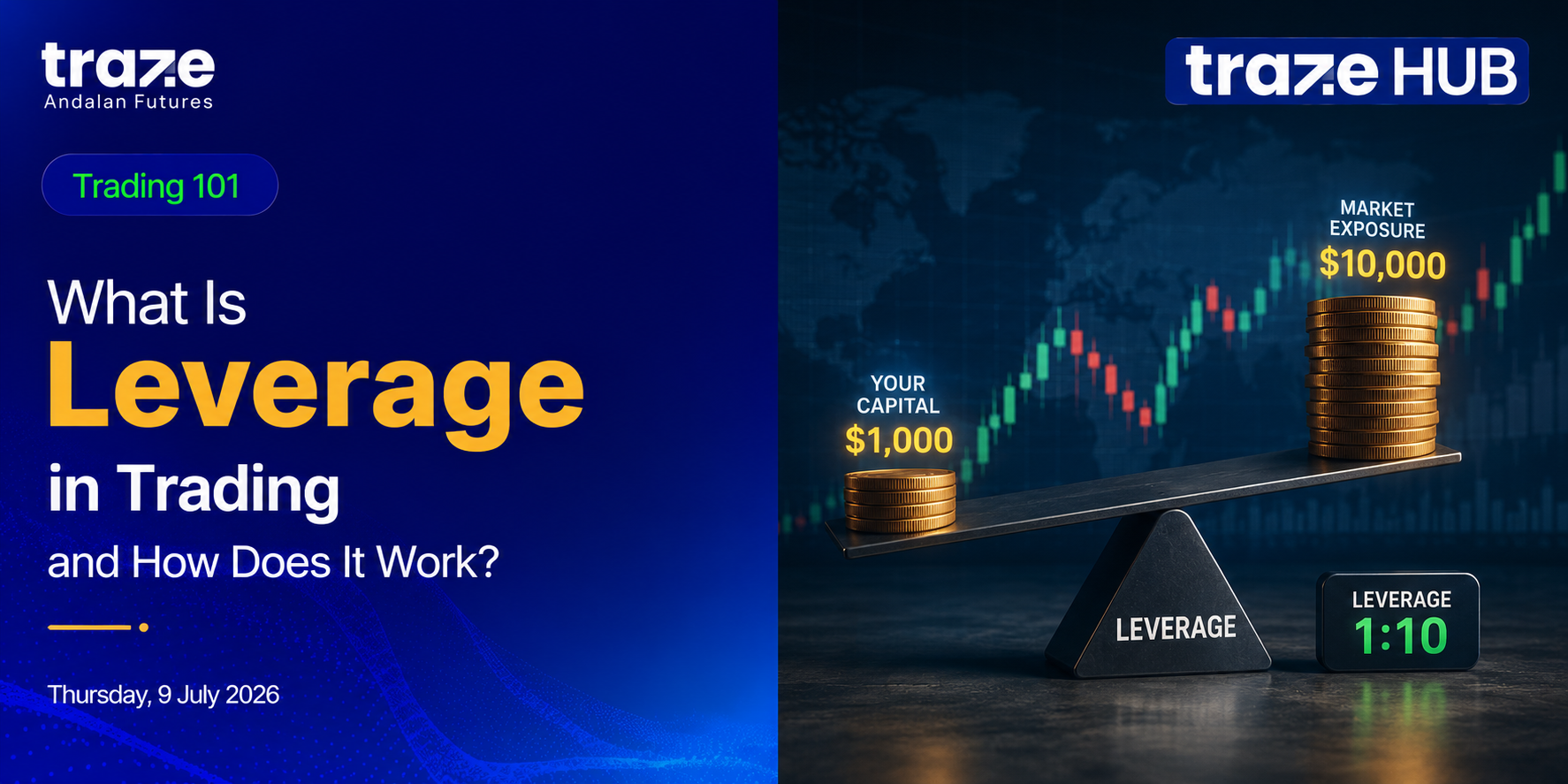
For example, imagine you have $1,000 in your trading account and use leverage of 1:10. In theory, this could allow you to control a position worth up to $10,000.
The relationship can be expressed as:
Position Size = Margin × Leverage
So, with:
- $1,000 margin
- 1:10 leverage
The resulting market exposure would be:
$1,000 × 10 = $10,000
However, controlling a larger position also means that relatively small market movements can have a greater impact on your account.
How Does Leverage Work in Practice?
Suppose a trader opens a $10,000 position using $1,000 of margin.
If the market moves 2% in the trader’s favor, the position gains:
$10,000 × 2% = $200
Relative to the $1,000 margin committed, that $200 gain represents 20%.
But leverage works in both directions.
If the market moves 2% against the trader, the position loses:
$10,000 × 2% = $200
That is also equivalent to 20% of the $1,000 margin committed.
This is why leverage is often described as a double-edged tool: it magnifies the financial impact of both favorable and unfavorable price movements.
What Is Margin?
Margin is the amount of capital required to open and maintain a leveraged position.
It is not necessarily a transaction fee or the full cost of the position. Instead, it acts as the capital allocated to support the leveraged exposure.
For example, if the margin requirement is 5%, opening a $20,000 position would require:
$20,000 × 5% = $1,000 margin
A 5% margin requirement corresponds mathematically to 1:20 leverage.
Leverage vs Margin
Leverage and margin describe closely related concepts from different perspectives.
Leverage describes how large a position can be relative to the capital used.
Margin describes how much capital is required to support the position.
For example:
- 1:10 leverage corresponds to a 10% margin requirement
- 1:20 leverage corresponds to a 5% margin requirement
- 1:50 leverage corresponds to a 2% margin requirement
- 1:100 leverage corresponds to a 1% margin requirement
The basic relationship is:
Margin Requirement = 1 ÷ Leverage
Why Do Traders Use Leverage?
Traders may use leverage for several reasons.
Capital Efficiency
Leverage can reduce the amount of capital required to gain a particular level of market exposure.
Instead of committing the full notional value of a position, a trader may only need to provide the required margin.
Access to Larger Positions
A trader with limited capital may be able to control a position larger than their account balance would otherwise allow.
However, a larger position also creates larger potential gains and losses for the same percentage market movement.
Flexible Capital Allocation
Because leveraged positions require only a portion of their notional value as margin, traders may retain capital for other purposes.
This does not automatically reduce risk. Opening multiple leveraged positions can increase total portfolio exposure and create additional risk.
What Are the Risks of Leverage?
Leverage can significantly increase trading risk.
Magnified Losses
The most direct risk is that losses are calculated based on the full position size, not simply the margin amount considered in isolation.
A relatively small adverse market movement can therefore create a substantial loss compared with the trader’s account equity.
Margin Calls
If account equity falls below required levels, a broker may issue a margin call or require additional funds, depending on the account structure and applicable rules.
Forced Position Closure
If losses continue and available margin becomes insufficient, positions may be automatically reduced or closed.
The exact process depends on the broker, platform, instrument, account type, and applicable regulations.
Market Gaps and Volatility
Markets do not always move smoothly.
During periods of high volatility, prices may change rapidly or gap between levels. In such conditions, an order may be executed at a different price from the one expected.
This can make leveraged positions particularly risky.
A Simple Leverage Example
Consider two traders who each have $5,000.
Trader A opens a $5,000 unleveraged position.
Trader B opens a $50,000 position using 1:10 leverage.
If the market rises by 1%:
- Trader A’s position gains $50
- Trader B’s position gains $500
If the market falls by 1%:
- Trader A’s position loses $50
- Trader B’s position loses $500
The market moved by exactly the same percentage for both traders. The difference comes from the size of their market exposure.
This illustrates an important principle:
Leverage does not make the market move more. It makes each market movement have a larger financial impact on the trader’s account.
Is Higher Leverage Better?
Not necessarily.
Having access to higher leverage does not mean a trader must use the maximum amount available.
For example, an account may permit leverage of up to 1:100, but a trader can still choose a much smaller position size and therefore use far less effective leverage.
The more useful question is not:
“How much leverage is available?”
It is:
“How much exposure am I actually taking relative to my account equity?”
This distinction is important because risk depends on actual position size, market volatility, stop placement, portfolio exposure, and available capital—not only the maximum leverage offered by a platform.
What Is Effective Leverage?
Effective leverage measures actual market exposure relative to account equity.
The formula is:
Effective Leverage = Total Position Exposure ÷ Account Equity
Suppose a trader has:
- $10,000 account equity
- $30,000 total market exposure
The effective leverage is:
$30,000 ÷ $10,000 = 3
The trader is effectively using 3:1 leverage, even if the account technically allows a much higher maximum.
This is often a more useful way to evaluate real exposure.
How Can Traders Manage Leverage Risk?
Several risk-management practices can help control leveraged exposure.
Use Smaller Position Sizes
A smaller position reduces the financial impact of each price movement.
Define Risk Before Entering a Trade
Before opening a position, determine how much of the account could be lost if the trade moves against you.
Understand Stop-Loss Limitations
Stop-loss orders can be useful risk-management tools, but they do not guarantee execution at the exact requested price in all market conditions.
Gaps, low liquidity, and rapid volatility may result in slippage.
Monitor Total Exposure
Risk should not be assessed one trade at a time only.
Several positions may be correlated. For example, multiple trades can effectively represent similar exposure to the same currency, sector, index, commodity, or broader market factor.
Keep Sufficient Available Margin
Using nearly all available margin can leave little room for normal market fluctuations.
A highly leveraged account may reach forced-close thresholds quickly during adverse price movements.
Key Takeaways
Leverage allows traders to control larger positions with less capital, but it increases the financial impact of market movements.
The most important points to remember are:
- Leverage increases market exposure
- Margin is the capital required to support a leveraged position
- Profits and losses are affected by the full position size
- Higher available leverage does not have to be fully used
- Effective leverage can be more informative than maximum account leverage
- Small adverse movements can create significant losses
- Position sizing and total exposure are central to risk management
Leverage is a tool, not a trading strategy. Used without careful risk management, it can rapidly increase losses. Before trading leveraged products, make sure you understand the instrument, margin requirements, liquidation rules, and the amount of capital at risk.
This content is provided for educational purposes only and does not constitute financial or investment advice. Trading leveraged financial products involves significant risk and may not be suitable for all investors.
 MyTraze